
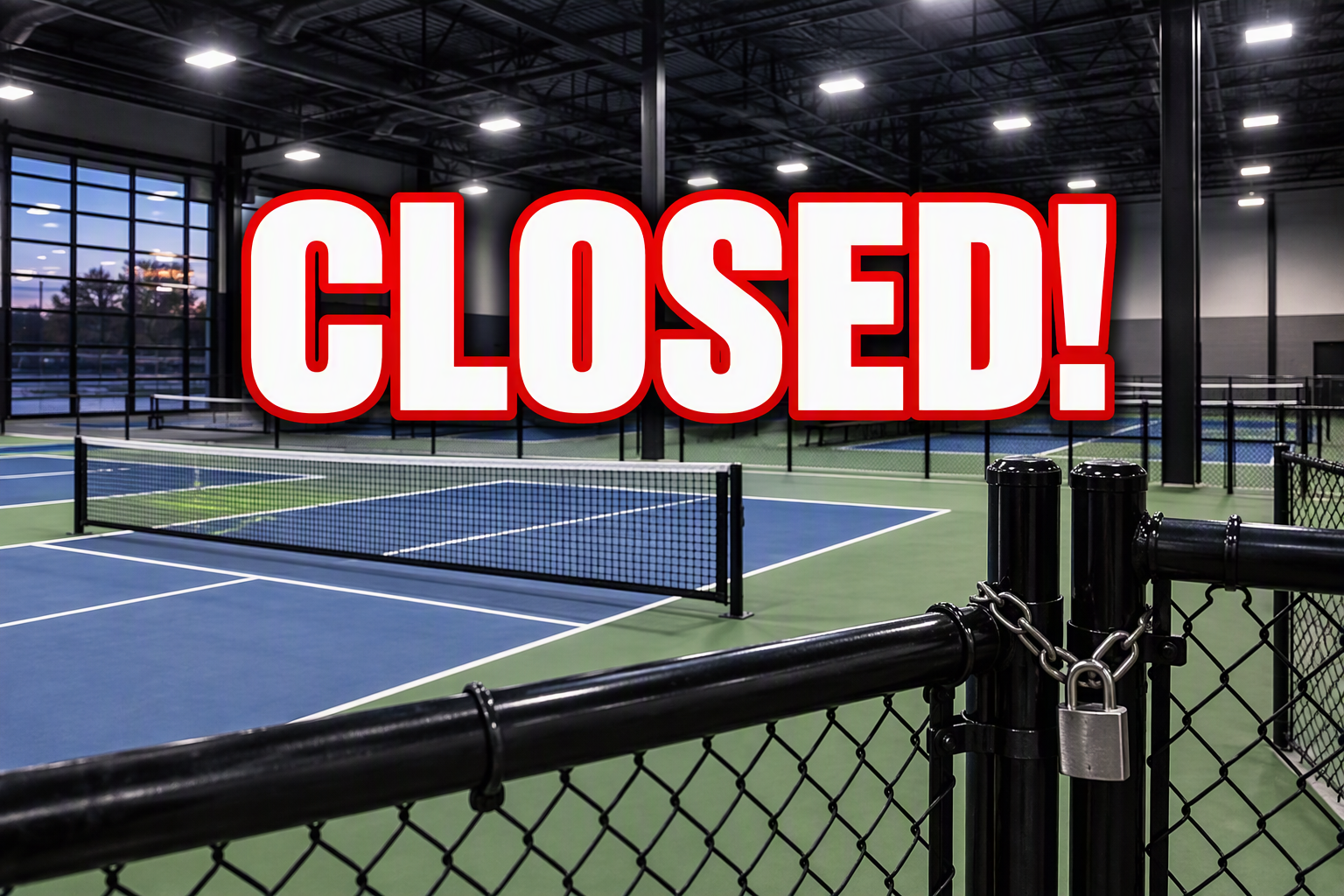
If you charge to play pickleball, you have to earn it! The pickleball courts at the park are free. The sun is out, the nets are up, and nobody is scanning a membership card. So, if a facility wants players to pay, it had better be selling a lot more than white lines and a net.
For players deciding where their game belongs – and for the facilities trying to keep them
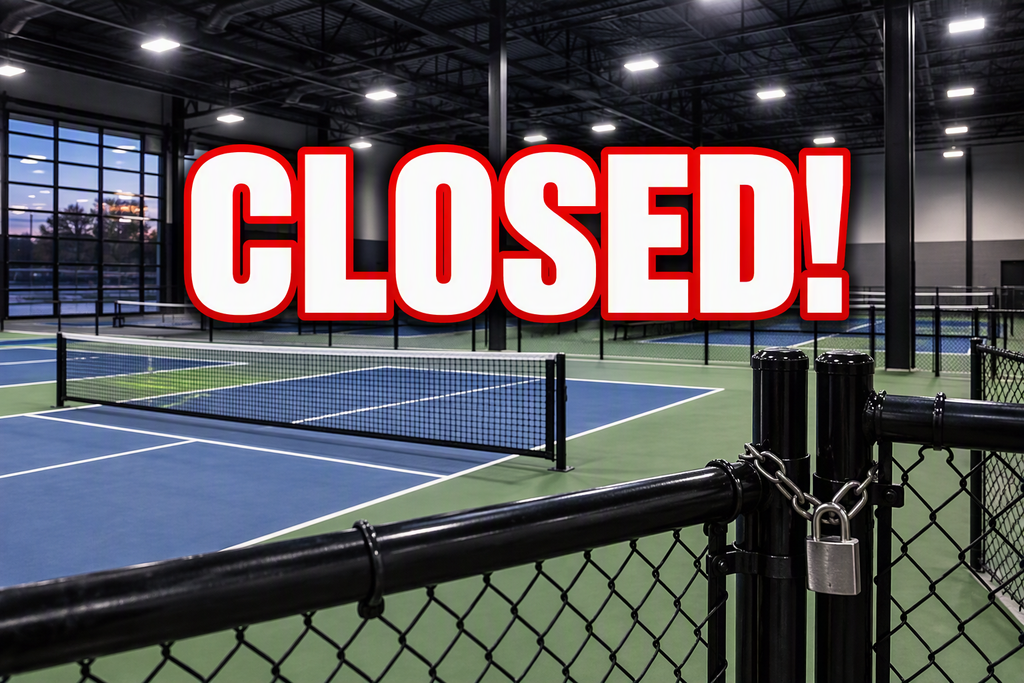
An indoor pickleball facility marked closed—a reminder that paid venues must offer value beyond court access.
Here is the honest question every paid pickleball facility must answer, out loud and without flinching: What are you offering that the free courts in the local parks do not have?
If the answer is just “courts,” the conversation is already over as the park has courts. In many towns it has a lot of them, they are well kept, and they cost the player nothing. You cannot charge people for the one thing they can already get for free, then act surprised when they stop coming.
That is not a knock on the sport. Pickleball is booming. Players are not disappearing – paying customers are choosing the free option when the paid option gives them no clear reason to stay. Facilities are closing not because people fell out of love with pickleball, but because some facilities never gave them a reason to love that place more than the park.
The community park is a tougher competitor than most facilities admit
Give the park its due. Pickleball courts at the park are free. It is outdoors on a beautiful morning. You show up with your paddle, stack it with everyone else’s, and you are in a game. No contract, no app, no monthly draft from your bank account. For a casual player who just wants to hit the ball and laugh for an hour, that is a very good deal.
Any facility that pretends the park is not good competition is fooling itself. The park sets the price at zero. Everything a paid facility does has to be measured against zero – and it has to win clearly enough that a player can explain the difference to a friend in one sentence.
Guaranteed time beats a free wait
The first thing money should buy is certainty. At the park, your court time is a gamble. You may walk right on. You might wait through three rotations while the same four players run it back. After you arrive, you may not get to play for many reasons.
A paid facility can end that gamble – if it actually does the work:
- Reservations that mean something. You book 10 a.m., you play at 10 a.m.
- Open play sorted by level. Beginners are not fed to 4.0 bangers, and advanced players are not stuck lobbing back softballs all morning.
- A full schedule, not an empty building. Drills in the morning, leagues at night, and someone in charge who knows your name and your game.
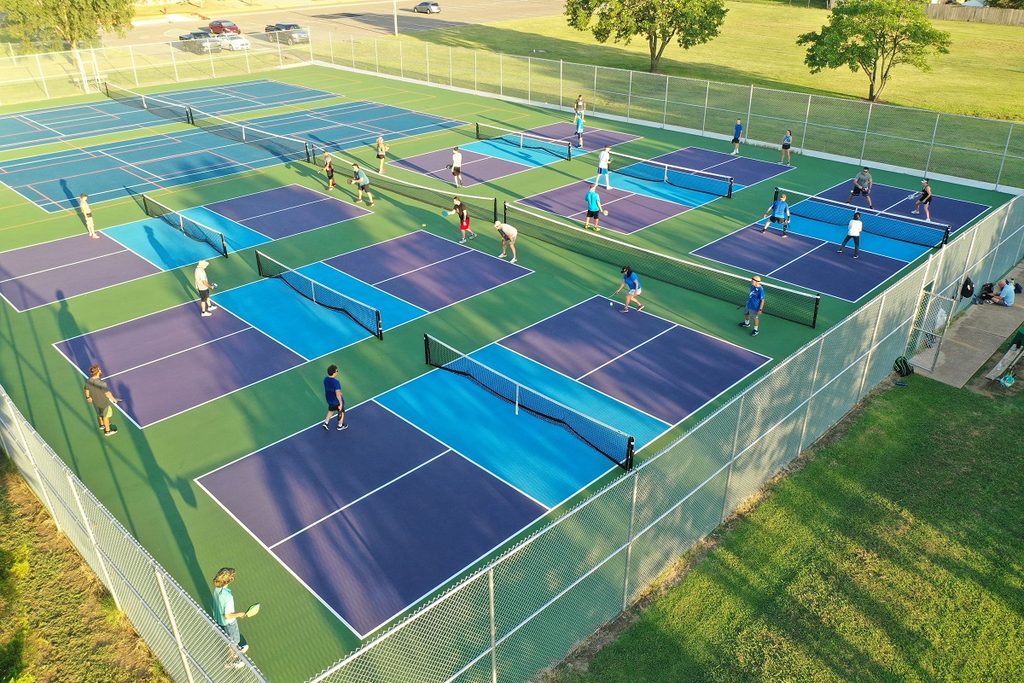
Free park courts, busy on a good day. The park wins on price and spontaneity. Paid play has to win on everything else. Photo: Park N Pool.
Weather does not get a vote
Rain cancels the park. Wind ruins the park. Summer heat empties the park by 10 a.m., and winter closes it for months in much of the country. A free court that you cannot use, is not much of a bargain.
A proper facility plays on schedule: a dedicated surface built for pickleball, even lighting with no sun in your eyes, no wind pushing a drop shot sideways, and a game in January that feels the same as a game in June. That consistency is not a luxury. For league players, lesson students, and anyone trying to build a real routine, it is the product.
Nobody pays for a court. They pay for the game they can count on, the help they cannot get alone, and the people they look forward to seeing.
Coaching is the one thing the park will never give you
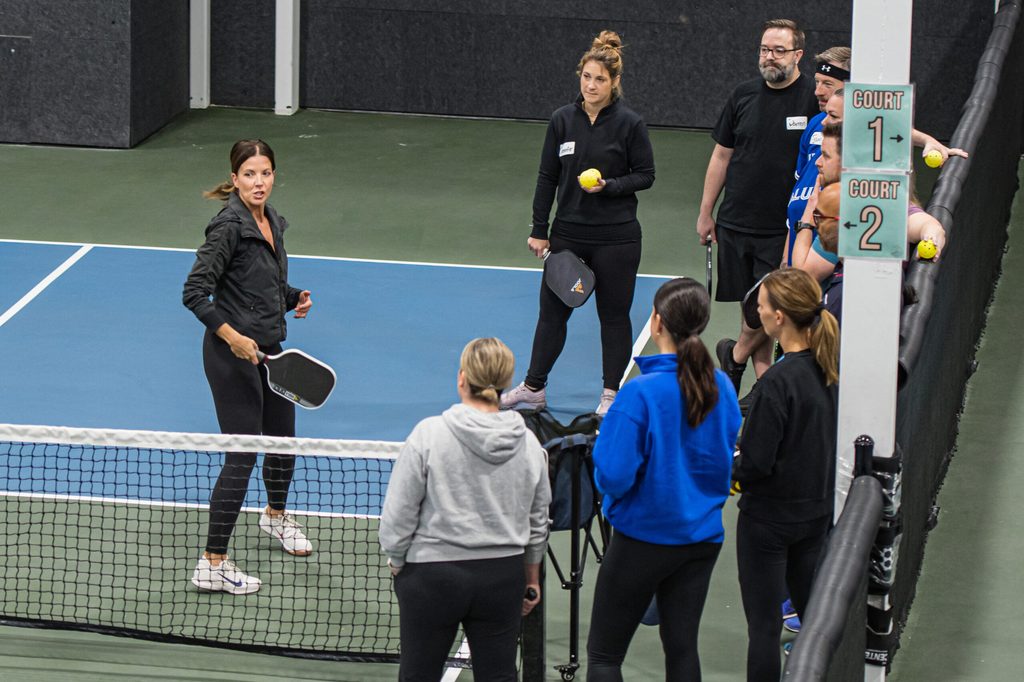
A clinic in session. A park can give you a game. It cannot fix your serve. Photo: Edmonton Pickleball Center.
At the park, you will play a thousand games and make the same fault a thousand times. Your serve will creep illegal. Your feet will wander into the kitchen. Nobody there is paid to stop you, tell you the truth, and fix it – nicely, and for good.
That is what a certified professional instructor is for. Lessons, clinics, and structured drilling turn “I keep losing to the same shot” into a plan. One good lesson can fix a serve you have been fighting for a year. No free court offers that, at any price.
People come for the pickleball. They stay for the people.
The strongest facilities are not really selling court time at all. They are running leagues that give your Tuesday a purpose, round robins where you meet players at your level, socials where a new player is welcomed instead of frozen out, and a front desk that notices when you have not been in for two weeks.
You came for the pickleball and stayed for the people – that line works because it is true everywhere this sport thrives. The park can host a good morning. A good facility builds a community you belong to, and belonging is very hard to get for free.
So why are facilities closing?
Recent reporting on indoor pickleball club’s points to the same pattern: high rents, buildings built bigger than the local player base could support, and memberships sold so aggressively that members could not get court time and cancelled. In October 2026, one large indoor franchisor filed for Chapter 11 while many independently run clubs kept operating. The lesson in that contrast is plain – the model failed in those places, not the sport, and not the players.
The facilities that last tend to be smaller, owner-run, and obsessive about programming. They know exactly what they offer that the park does not, and they prove it every week.
| The one-sentence test Before any facility takes another dollar, it should pass this test: can a happy member finish this sentence in one breath – “I pay because here I get _______, and I cannot get that at the park”? If the blank fills easily – a reserved court, a coach who fixed my game, my league, my people – that facility will be fine. If it stays blank, the park already won. |
What can we do to support our facilities?
Players can help by showing up consistently, joining a league or clinic, bringing a friend, and spending where they see real value. Just as important, we can give owners honest feedback, recognize the staff members who create a welcoming culture, and support the programs that turn a building full of courts into a community. A strong facility still must earn our business—but when it does, keeping it open becomes something we all have a hand in.
Sources and further reading: Men’s Journal, “Pickleball Is Booming, So Why Are Indoor Clubs Going Broke?” (Oct. 14, 2026); Inc., reporting on The Picklr Chapter 11 filing (Oct. 2026). Photo credits are given in the captions.