
Yes, it’s fall and we are almost to Halloween. There are many things in pickleball that are scary, like standing at the kitchen-line, getting hit by a ball and playing against a 4.5 player. Unfortunately, there is something even scarier! That Pickleball you’re playing with, is dead!
We’ve all been there: you’re out on the court, your dinks feel slightly dead, your drives aren’t popping off the paddle the way they usually do, and you keep having erratic, unpredictable bounces on standard court surfaces. You might blame your paddle, the wind, or just write it off as an “off day.”
But before you spend hundreds of dollars upgrading your gear or tweaking your mechanics, take a close look at the plastic sphere in your hand.
Most players are shocked to learn how short the functional lifespan of a pickleball actually is. If you’ve been pulling the exact same ball out of your bag for two weeks straight, you aren’t playing with a “broken-in” ball—you’re playing with a structurally compromised piece of plastic that is actively sabotaging your control, power, and consistency.
Here is the deep dive into why pickleballs fail, what it actually costs you per year, and how to tell when it’s time to retire a ball to the practice bucket.
The Hidden Failure Modes of Plastic Balls
Unlike tennis balls that gradually lose their felt fuzz or golf balls that simply get scuffed, pickleballs are made of molded polyethylene plastic. They don’t wear out gracefully; they fail in one of two distinct ways depending on where you play:
1. Outdoor Balls: Material Fatigue & Cracking
Outdoor balls (like the Franklin X-40 or Dura Fast 40) feature 40 precision-drilled holes designed to cut through wind and withstand rough asphalt or acrylic courts. However, hard court friction combined with high-velocity overhead slams and drives creates immense structural stress.
- Average Outdoor Lifespan: 3 to 10 games (roughly 3 to 10 hours of competitive play).
- Primary Failure: Micro-cracks along the drilled hole edges or molded seams that eventually lead to a full split.
2. Indoor Balls: “Egging” & Softening
Indoor balls (like the Onix Fuse or Gamma) feature 26 larger holes and are typically made of a slightly softer plastic formulation designed for smooth wood or gym surfaces.
- Average Indoor Lifespan: 20 to 40 games (roughly 20 to 40 hours of play).
- Primary Failure: Structural softening and loss of roundness (“egging”) rather than outright cracking.
What Happens to a “Dead” Ball After 2 Weeks?
Even if a ball hasn’t visibly cracked into two pieces, plastic suffers from severe material fatigue over repeated impacts. Here is what is happening to a ball that’s been used for a couple of weeks:
1. Up to 20% Loss of Bounce Height
As the plastic flexes repeatedly, the internal wall memory weakens. A fatigued ball absorbs paddle energy rather than springing off it, resulting in a significantly lower, flatter bounce that ruins your timing and paddle feel.
2. Oval Deformation (“Egging”)
A fresh pickleball is a true sphere. After dozens of hard-hitting rallies, the structural wall develops unequal tension. The ball warps into a subtle oval. You’ll notice this when a ball rolls erratically or takes a sudden sideways dart upon bouncing.
3. Micro-Flexing Soft Spots
Hairline structural fractures around the drilled holes allow the ball to yield slightly when struck. Soft spots absorb impact force, killing the velocity on your drives and making your soft game feel mushy and unresponsive.
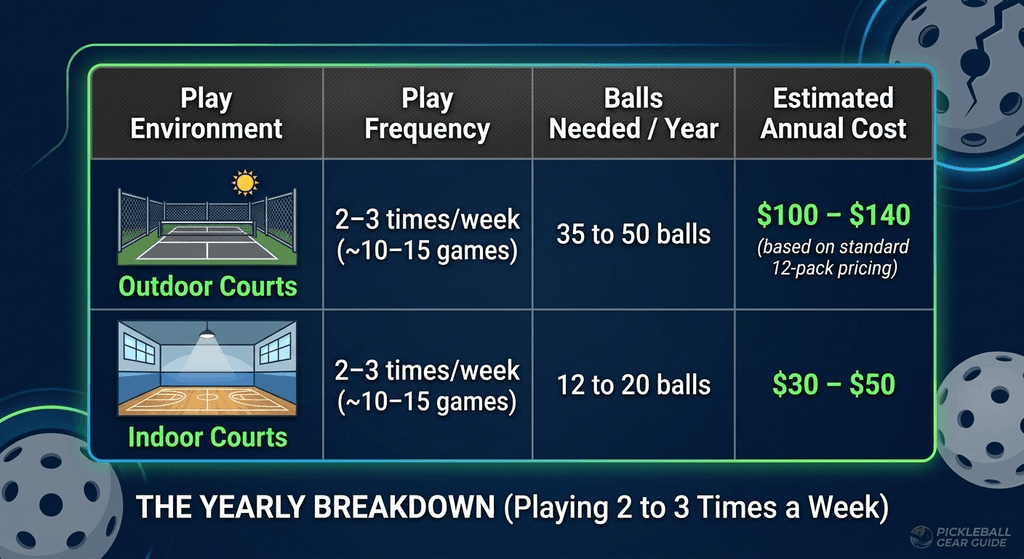
The Yearly Math: How Many Balls Do You Actually Need?
If you hit the courts 2 to 3 times per week (averaging 4 to 6 games per session), your annual ball consumption and costs add up faster than you might think. While spending $100+ a year on plastic balls might feel frustrating, playing with expired balls costs you far more in terms of skill progression, consistency, and match results.
3 Critical Factors That Accelerate Ball Breakdown
- Temperature (The Biggest Variable): When playing in temperatures below 50°F (10°C), plastic becomes extremely brittle. Cold weather impacts can reduce an outdoor ball’s life from 10 games down to just 1 or 2 games before cracking. In contrast, extreme heat (above 90°F / 32°C) softens plastic, causing balls to warp and go soft without cracking.
- Player Style: Aggressive power players, heavy bangers, and players with big overhead slams put exponentially more mechanical force on the ball wall than dink-heavy finesse players.
- Court Texture: Coarse, gritty asphalt courts act like fine sandpaper, thinning the outer walls of the ball and accelerating structural collapse compared to smooth indoor gym floors.
The 5-Second Field Test: Is Your Ball Dead?
Before your next match, run your ball through these four quick checks:
- The Side-by-Side Drop Test: Drop your current ball and a brand-new ball simultaneously from chest height onto the court. If your current ball bounces noticeably lower, it has lost its spring and should be retired.
- The Squeeze Test: Place your thumbs near opposite poles of the ball and press inward. If one area flexes noticeably easier than the rest, the wall has suffered micro-fractures.
- The Roll Test: Roll the ball across a flat table or court surface. If it wobbles, veers, or hops, it has lost its spherical shape (“egged”).
- The Light Check: Hold the ball up against a bright light source or sunlight and inspect the perimeter of each drilled hole for tiny, hairline splits.
Final Takeaway
Pickleballs are consumables—they are designed to be replaced regularly.
Don’t let a fatigued, squishy $3 ball ruin your hard work, practice, and game strategy. Keep your extra balls warm in cold weather, inspect your gear regularly, and when in doubt, crack open a fresh ball to keep your play sharp, fast, and predictable!